Erik Moberg ©:
10.
THE ASYLUM SEEKERS FROM BALKAN
As seen in (the repeated) Diagram 4 the migration
streams from the Balkan countries reached a most considerable peak in 2015. And
even if the patterns differ for the different countries this is remarkable in
two ways. First, there have not been any particular events or disturbances
triggering the migration. During all the period considered here things have, on
the whole, been quite normal. But still, and second, the numbers of asylum
seekers, as percentages of the populations, have been remarkably high. Thus,
and in this respect, Kosovo easily comes first among all countries dealt with
here (see the former Table 2), Albania comes second, Macedonia fifth and Serbia
sixth (among, it may be repeated, 18 countries). This combination of lack of
obvious, sudden reasons and large scale emigration is quite remarkable. How can
it be explained?
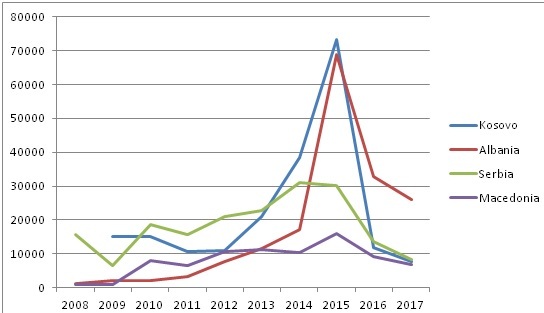
Diagram 4 (repeated): Asylum seekers in the EU/EFTA
from Balkan
The explanation has, I think, to take two sets of
circumstances into account. The first one is about the conditions in these
countries. Albania, as we know, was until 1985 a communist dictatorship run by Enver Hoxha, but then, after his
death, it has been democratized, although not completely. Among others
corruption is still a severe problem and the legal system is politicized. Going
then to Kosovo, Serbia and Macedonia they were earlier parts of marshal Tito’s
Yugoslavia, and they belonged to the southern part of that country to a large
extent characterized by Islam and by non-western values. In Kosovo, furthermore,
there is since it creation a serious conflict between the Albanian majority part
of its population and the Serbian minority. Still earlier all of these
countries, as well as Albania, were parts of the Ottoman Empire. And, as in Albania, and since politics is corrupt and working
badly, many people lack all hope for the future and in particular for their
children. Hence, and since long, lots of people want to find some better
place for living than their own country.
The second set of circumstances is about the migration
streams from the Middle and the Far East. These streams have to a considerable
extent passed through the Balkan countries and, when so doing, have, in all
likelihood, had some kind of triggering or contaminating effect. An effect like
that I discussed in the earlier section about the asylum from Iran, and here
the problem is the same. For the sudden very rapid expansion of emigration–and
that is so for both Balkan and Iran–I cannot find any other explanation.
–
* –